

Paris, 1957. The world of high fashion is in mourning because Christian Dior, the man who changed the way women saw elegance, has died suddenly. The future of the famous fashion house is now up in the air. After Dior died, the work at the atelier almost stopped completely. Customers canceled their orders, employees waited for news, and the press talked about who could fill his shoes. The house was on the edge of uncertainty because too much depended on the name and not enough on the structure.
At this point, the management took a big risk by giving the company’s future to a 21-year-old designer named Yves Saint Laurent. He was humble, paid attention to detail, and had been working with Dior for a few years, learning everything from how to cut the fabric to the brand’s philosophy. From that point onward, Yves Saint Laurent began wowing the world with his timeless creations, so popular that most of them nowadays need to be checked using special Saint Laurent legit check tools.
First Steps of Young Yves In Dior’s Shadow
Saint Laurent was born and raised in Oran, French Algeria, and was interested in fashion and drawing from a young age. He moved to Paris in 1953 and started going to the École de la Chambre Syndicale de la Couture. Soon enough, he won a contest for young designers and got a job at Dior, where he started as an assistant and later became the maestro’s right-hand man.
Saint Laurent came to the Dior atelier for the first time in 1955. Christian himself quickly saw how talented the young man was: his work showed a strong sense of style, raw vision, and a natural understanding of proportions.
Yves learned the art and discipline of fashion from his master. When Dior died suddenly, his protégé was offered the job of artistic director. That’s the story of how the 21-year-old designer became the youngest couturier in Paris.
How Yves Saint Laurent Truly Saved the House of Dior
For Saint Laurent, 1957 was a tough year that he couldn’t have prepared for. Journalists, critics, clients, and investors in the fashion world were all watching him, holding their breath.
The Trapeze Line, his first collection for Dior, came out in January 1958. In contrast to Christian Dior’s collections in the past, it wasn’t stiff and heavy. Instead, the shapes got more open, the fabrics got lighter, and the movement got more natural. The dresses in this line fell freely from the shoulders and had a soft volume that made them look like they were floating in the air. No longer did women need corsets to be feminine; femininity became an inner feeling instead of a constructed shape.

Source:
This served as a signal to the industry that fashion was no longer subject to rigid rules. The trapezoidal silhouette offered women a previously unmatched comfort and designers new freedom. Contrary to what some say, Saint Laurent did not break with Dior’s style; he simply made it more contemporary.
Customers came back to Dior boutiques as a result of the collection’s great success, and the House’s financial metrics started to rise once again. In addition to keeping the Dior name alive, Yves gave high fashion a fresh perspective.
Scandal and Success on the Paris Runway
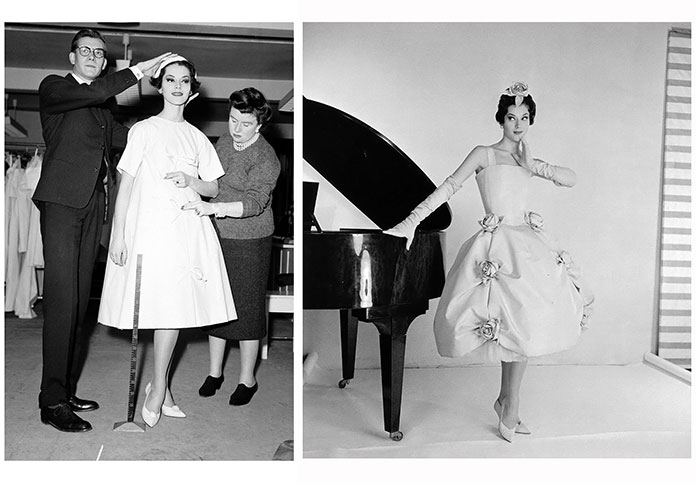
In 1958, the debut of Saint Laurent was hailed by the press as one of the decade’s most talked-about shows. The Trapeze Line was described by Vogue as “a whisper of youth in a house built on perfection.”
The public’s response varied; some thought the new lines were too daring, while others thought they were a natural extension of the House’s spirit. Foreign publications reported on the revival of optimism in French couture, and buyers praised the silhouettes’ lightness and the cut’s comfort.
Orders for the Trapeze collection surpassed projections in the coming months. The outcome was obvious: Saint Laurent emerged as the new face of Parisian fashion, and the collection gave the House of Dior both public and commercial success.
Beginning of Yves Saint Laurent
Yves had a brief career at Dior despite his enormous success. After a few seasons, investors and management started to put pressure on him. In 1960, Saint Laurent was drafted into the French army and suffered from mental health issues, which forced the House’s management to replace him with a new designer. For him, this was a pivotal moment. Just a while after, Saint Laurent and Pierre Bergé established their own fashion label, Yves Saint Laurent, in 1961.
Fashion was no longer merely a luxury after that. Women’s tuxedos, safari jackets, sheer blouses, and the Rive Gauche ready-to-wear line, which for the first time made design affordable for the masses, were among the pieces in his collections that transformed the decade’s fashion.
From Dior’s Protégé to a Global Icon
Saint Laurent’s journey, from the modest Dior atelier to the world’s catwalks, came to represent the development of fashion. He kept Dior’s dream alive and transformed it into a new way of thinking: clothing should liberate, not restrict. His Rive Gauche revolution changed the way women felt and dressed by bringing haute couture to the streets.
Since then, Yves Saint Laurent has become synonymous with inner freedom in addition to style. Designers are still influenced by his approach to form and personality, and the harmony he established between boldness and classicism is still the gold standard, a representation of liberty, refinement, and classic beauty.
That time frame is now regarded as an important turning point. In addition to maintaining the House’s reputation, the young designer established a trend that would later be adopted by dozens of other brands. His narrative serves as an illustration of how skill and meticulousness can alter the system without making overt claims.
That’s all ! © Glamourdaze